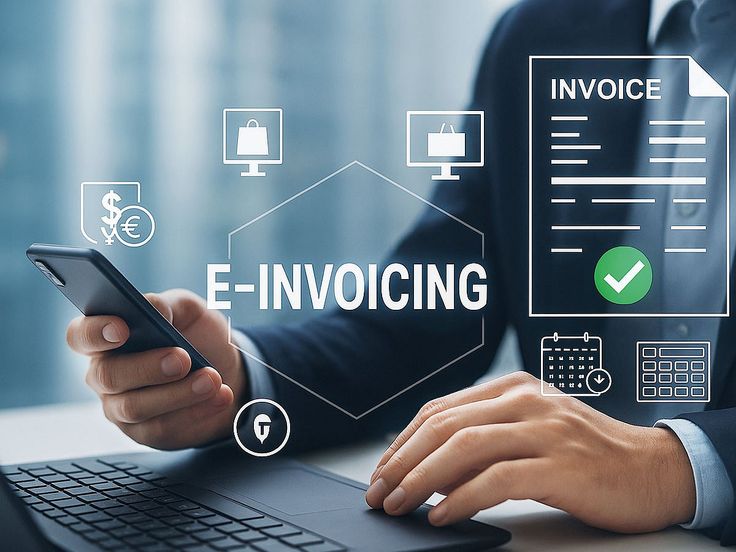
The UAE is in the midst of a significant digital transformation of its tax infrastructure. Following the global trend of mandatory electronic invoicing, the UAE has introduced a phased e-invoicing framework that will fundamentally change how businesses issue and receive invoices.
If your business is not already preparing, now is the time to act. This guide explains what the UAE e-invoicing mandate means, who is affected, the implementation timeline, and the practical steps your business needs to take.
What Is UAE E-Invoicing?
UAE e-invoicing — or electronic invoicing — replaces paper and PDF invoices with structured, machine-readable digital documents that are exchanged via a government-connected network and reported to the Federal Tax Authority (FTA) in real time or near real time.
Unlike simply emailing a PDF invoice, true e-invoicing involves creating invoices in a standardised electronic format (typically XML or JSON), transmitting them through a certified Access Point, and having them automatically validated against FTA systems.
The UAE e-invoicing framework is built on the Peppol (Pan-European Public Procurement Online) standard, which is also used in Singapore, Australia, and across Europe. This means UAE businesses will interoperate on a globally recognised system.
The UAE E-Invoicing Framework: Key Components
Decentralised Continuous Transaction Control (DCTC)
The UAE has adopted a decentralised model where invoices are exchanged directly between buyer and seller through certified Access Points, with data simultaneously reported to the FTA.
Peppol Network
The UAE has joined the global Peppol network as a Peppol Authority. Businesses will connect to the network via Peppol-certified service providers.
Five-Corner Model
The UAE uses a 5-corner model — Supplier → Supplier Access Point → FTA Platform → Buyer Access Point → Buyer — ensuring both real-time FTA reporting and direct delivery to the buyer.
UBL 2.1 Format
Invoices must be in Universal Business Language (UBL) 2.1 XML format, ensuring structured, machine-readable data.
UAE E-Invoicing Implementation Timeline
The UAE e-invoicing rollout is phased:
Phase 1 (Large Taxpayers)
Large businesses and government entities are in the initial implementation wave. If you have received communication from the FTA, you should already be preparing.
Phase 2 (Medium Businesses)
Medium-sized businesses will follow in subsequent phases as defined by the FTA based on annual revenue thresholds.
Phase 3 (SMEs)
Small and medium enterprises will be brought into the system in later phases. The FTA communicates implementation wave assignments directly to taxpayers via EmaraTax. Businesses should monitor their EmaraTax accounts and any official FTA communications closely.
Who Is Affected by UAE E-Invoicing?
The e-invoicing mandate applies to all taxable persons registered for VAT in the UAE. This includes:
- Mainland UAE companies
- Free zone entities registered for VAT
- Foreign businesses with a UAE VAT registration
Both B2B (business-to-business) and B2G (business-to-government) transactions are within scope. The framework will ultimately cover B2C transactions as well in later phases.
What Your Business Needs to Do
- Assess your readiness: Review your current invoicing process. Do you use accounting software? Can it generate UBL 2.1 XML invoices? Does your ERP integrate with Peppol?
- Choose a certified Access Point Provider: You must connect to the Peppol network through a UAE-certified Access Point Provider. Several technology providers are now active in the UAE market.
- Update your systems: Your accounting or ERP system will need to be updated or integrated to generate compliant e-invoices. Work with your software vendor to confirm their UAE e-invoicing support.
- Train your team: Finance and accounts payable teams need to understand the new process — from generating and sending e-invoices to receiving and processing them.
- Update your supplier and customer relationships: E-invoicing is a two-way process. Your suppliers will also need to send you compliant e-invoices. Communicate with key suppliers early.
- Test before go-live: The FTA provides testing environments. Conduct thorough testing before your mandatory go-live date to avoid disruption to your billing cycle.
Common Compliance Mistakes to Avoid
- Waiting until the last minute — system integrations and testing take time
- Assuming your current accounting software is automatically compliant without checking
- Failing to register with a certified Access Point Provider ahead of your go-live date
- Not updating your invoice template fields to meet Peppol UBL 2.1 requirements
- Ignoring FTA communications about your specific implementation wave
Benefits of E-Invoicing Beyond Compliance
While e-invoicing is a compliance mandate, it brings genuine operational benefits:
- Faster payment cycles — structured invoices are processed and approved faster
- Reduced data entry errors — automated matching eliminates manual keying mistakes
- Lower invoice processing costs — studies show e-invoicing can cut invoice processing costs by 60-80%
- Improved audit trail — all invoices are automatically stored and reportable
- Streamlined VAT compliance — accurate invoice data makes VAT return preparation easier
How Elysian Helps with UAE E-Invoicing
Elysian Consulting Group provides comprehensive e-invoicing implementation support, including:
- E-invoicing readiness assessment for your business
- Vendor evaluation and Access Point Provider selection
- System integration advisory and project management
- Staff training on e-invoicing processes
- Ongoing compliance monitoring and FTA liaison
We work with businesses of all sizes to ensure a smooth, on-time transition to the UAE’s mandatory e-invoicing system.
Get your e-invoicing readiness assessment — contact Elysian at elysianuae.com/contact/
Frequently Asked Questions
Q: Is e-invoicing mandatory for all UAE businesses?
It will be mandatory for all VAT-registered businesses in the UAE. Implementation is phased based on business size.
Q: Can I still send PDF invoices once the mandate applies to me?
No. Once in your implementation wave, PDF and paper invoices will not be compliant for B2B and B2G transactions. You must use the Peppol e-invoicing network.
Q: What is an Access Point Provider?
A certified technology provider that connects your systems to the UAE Peppol network and the FTA platform. You cannot send e-invoices without one.
Q: Does e-invoicing replace my VAT return?
No. VAT returns are still required. However, the data from your e-invoices will flow to the FTA, making VAT compliance more automated over time.
Q: What software supports UAE e-invoicing?
Major ERP vendors (SAP, Oracle, Microsoft Dynamics) and accounting platforms are adding UAE e-invoicing support. Check with your software vendor for their roadmap and certified Access Point integrations.