Updated for 2026
The UAE’s tax landscape has evolved significantly over the past few years. The introduction of Value Added Tax (VAT) in January 2018 and Corporate Tax (CT) for financial years beginning on or after 1 June 2023 has created new compliance responsibilities for businesses across the UAE.
While both taxes are administered by the Federal Tax Authority (FTA), VAT and Corporate Tax serve very different purposes. VAT is primarily a consumption tax, while Corporate Tax is imposed on taxable business income.
For SMEs, startups, mainland businesses, and Free Zone companies, understanding the difference between UAE VAT and Corporate Tax is essential for accurate registration, accounting, filing, and tax compliance.
If you are wondering, “Do I need to pay both VAT and Corporate Tax?”, “Does Corporate Tax apply to my Free Zone company?”, or “How will these taxes affect my business?”, this guide explains the key differences in simple terms.
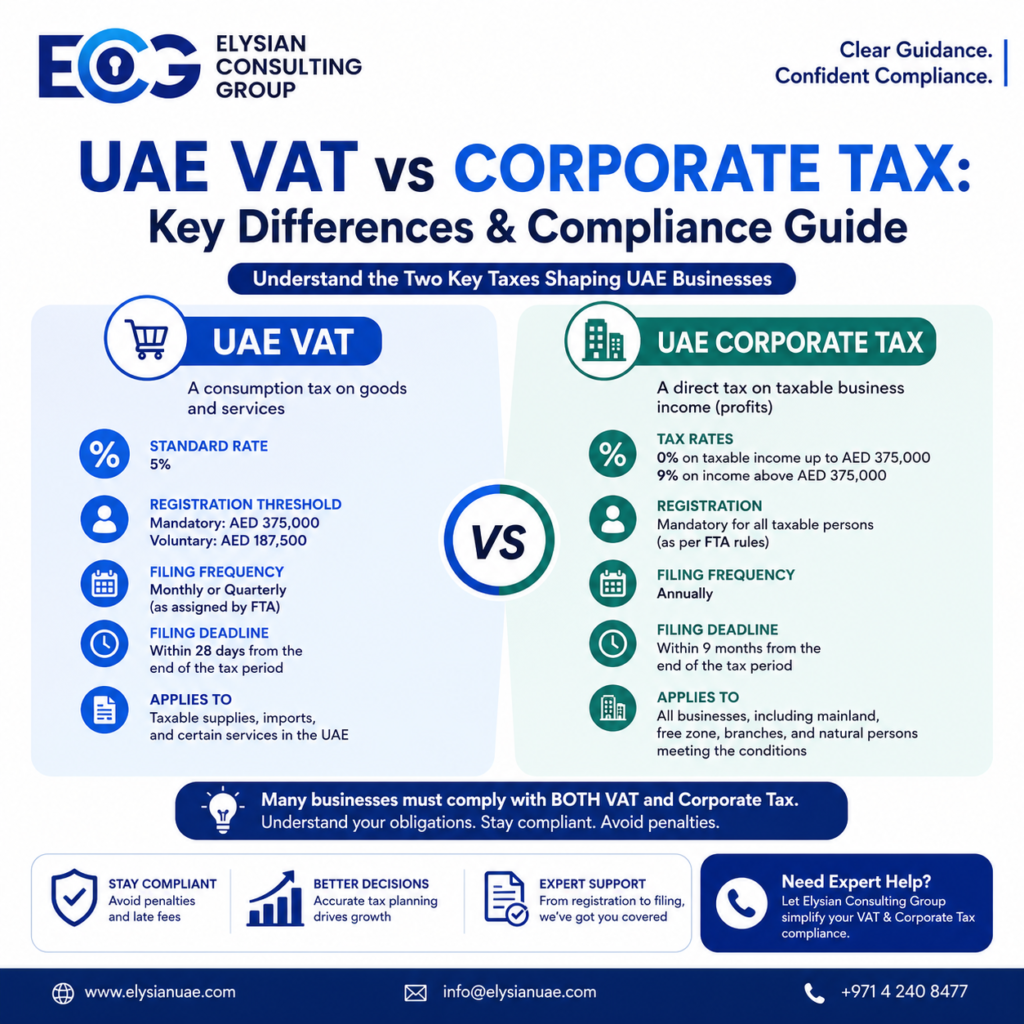
VAT vs Corporate Tax in the UAE: At a Glance
| Particular | UAE VAT | UAE Corporate Tax |
|---|---|---|
| Tax type | Indirect consumption tax | Direct tax on taxable business income |
| Introduced | 1 January 2018 | Announced in 2022; effective for financial years beginning on or after 1 June 2023 |
| Standard rate | 5% | 0% up to AED 375,000 of taxable income; 9% on taxable income exceeding AED 375,000 |
| Main basis | Taxable supplies and imports | Taxable income |
| Mandatory registration | Generally when taxable supplies/imports exceed AED 375,000 | Tax registration requirements depend on the type of taxable person |
| Voluntary registration | Available from AED 187,500 for eligible UAE-resident businesses | No equivalent voluntary registration threshold |
| Filing frequency | Based on the VAT tax period assigned by the FTA | Generally annual, based on the tax period |
| Filing deadline | Within 28 days from the end of the VAT tax period | Within 9 months from the end of the tax period |
| Free Zone businesses | VAT rules can apply | Qualifying Free Zone Persons may benefit from 0% on Qualifying Income, subject to conditions |
The important point is that VAT and Corporate Tax are separate obligations. A business can be required to comply with both.
Understanding VAT in the UAE
UAE VAT was introduced on 1 January 2018 at a standard rate of 5%. It is an indirect tax generally charged on taxable goods and services supplied in the UAE and on certain imports.
VAT is collected throughout the supply chain. Businesses generally charge output VAT on taxable sales and may recover eligible input VAT incurred on business purchases, subject to the UAE VAT rules.
The ultimate economic burden of VAT generally falls on the final consumer, while registered businesses act as collectors and account for VAT to the FTA.
What Does UAE VAT Cover?
VAT can apply to various transactions, including:
- Taxable goods and services supplied in the UAE
- Certain imported goods and services
- Zero-rated supplies, where applicable
- Transactions involving businesses operating in mainland and Free Zone environments, depending on the nature and place of supply
Not every transaction is subject to VAT at 5%. Certain supplies may be zero-rated or exempt, and the VAT treatment depends on the specific transaction and applicable UAE VAT legislation.
For example, eligible exports may be zero-rated. This means VAT is charged at 0%, while qualifying input VAT may generally remain recoverable.
UAE VAT Registration Threshold
For UAE-resident businesses, VAT registration is generally mandatory when the value of taxable supplies and imports exceeds AED 375,000 over the previous 12 months or is expected to exceed that amount in the next 30 days.
A business may also be eligible for voluntary VAT registration when the value of taxable supplies, imports, or taxable expenses exceeds AED 187,500, subject to the applicable conditions.
The registration thresholds are based on taxable supplies and relevant imports/expenses, rather than simply using total accounting revenue.
UAE VAT Return Filing and Payment
Once registered for VAT, a business must file its VAT return and settle the related VAT liability within 28 days from the end of its VAT tax period.
The VAT tax period is not necessarily the same for every business. The FTA may assign a monthly or quarterly tax period depending on the taxpayer’s circumstances.
VAT returns are generally submitted electronically through the EmaraTax platform.
Businesses should maintain accurate records of:
- Sales and output VAT
- Purchases and input VAT
- Tax invoices
- Credit notes and debit notes
- Import transactions
- Zero-rated and exempt supplies
- VAT reconciliations
- Supporting documentation
Proper VAT accounting helps businesses reduce errors, avoid unnecessary penalties, and accurately claim eligible input VAT.
Need professional VAT support?
Explore Elysian Consulting Group’s UAE VAT Services
Understanding Corporate Tax in the UAE
UAE Corporate Tax was announced in 2022 and became effective for financial years beginning on or after 1 June 2023.
Unlike VAT, which is generally charged on taxable transactions, Corporate Tax is a tax on taxable income.
The UAE Corporate Tax regime is part of the country’s broader efforts to align its tax framework with international standards while supporting sustainable economic growth and diversification.
Who Is Subject to UAE Corporate Tax?
Corporate Tax can apply to businesses and other persons that fall within the scope of the UAE Corporate Tax Law, including:
- UAE-incorporated companies and other juridical persons
- Certain UAE branches and foreign businesses
- Free Zone entities
- Businesses conducted by natural persons where the relevant conditions are met
For natural persons, Corporate Tax applies only where they conduct a business or business activity in the UAE and their business revenue exceeds AED 1 million in a calendar year. Salary income, personal investment income, and real estate investment income are excluded from this business-revenue test under the applicable rules.
UAE Corporate Tax Rates
The standard UAE Corporate Tax rates are:
- 0% on taxable income up to AED 375,000
- 9% on the portion of taxable income exceeding AED 375,000
The AED 375,000 threshold relates to taxable income, not simply annual turnover or revenue.
For example, if a business has AED 1 million of taxable income, the first AED 375,000 is subject to 0% Corporate Tax, while the remaining AED 625,000 is subject to 9%, resulting in a Corporate Tax liability of AED 56,250 before considering applicable adjustments, reliefs, or tax credits.
Small Business Relief: What SMEs Should Know
Eligible UAE resident businesses may be able to elect for Small Business Relief where their revenue is AED 3 million or less in the relevant tax period and all previous tax periods, subject to the applicable rules.
The relief treats an eligible business as having no taxable income for that tax period.
However, Small Business Relief is not available to Qualifying Free Zone Persons or members of certain large multinational enterprise groups. The AED 3 million threshold applies to eligible tax periods ending on or before 31 December 2026 under the current rules.
Businesses should therefore assess eligibility carefully rather than assuming that every SME automatically qualifies.
Corporate Tax Registration and Compliance
Corporate Tax registration requirements depend on whether the taxpayer is a juridical person, natural person, or another type of taxable person.
Juridical persons subject to Corporate Tax are required to register with the FTA and obtain a Corporate Tax Registration Number according to the applicable registration timelines. Natural persons conducting a business are required to register when their business revenue exceeds AED 1 million in a calendar year.
Corporate Tax compliance generally involves:
- Corporate Tax registration
- Maintaining proper accounting records
- Preparing financial statements
- Determining taxable income
- Making applicable tax adjustments
- Reviewing deductible and non-deductible expenses
- Maintaining supporting documentation
- Assessing related-party and transfer-pricing requirements where applicable
- Filing the Corporate Tax return
- Paying Corporate Tax within the prescribed deadline
A Corporate Tax return and related payment are generally due within nine months from the end of the relevant tax period.
Corporate Tax for UAE Free Zone Companies
One of the most common misconceptions is that Free Zone companies are automatically exempt from Corporate Tax.
That is not correct.
Free Zone Persons are generally within the Corporate Tax framework and must comply with applicable registration and filing requirements. However, a Qualifying Free Zone Person (QFZP) may benefit from a 0% Corporate Tax rate on Qualifying Income, provided it meets the conditions under the applicable rules.
Income that does not qualify for the 0% treatment may be subject to the standard 9% Corporate Tax rate.
The conditions for QFZP status can include requirements relating to:
- Adequate substance in the UAE
- Qualifying Income
- Qualifying and excluded activities
- Transfer pricing compliance
- Appropriate documentation and record keeping
- Other requirements prescribed under the Corporate Tax legislation
Therefore, Free Zone businesses should not assume that having a Free Zone licence automatically means all income is taxed at 0%.
VAT vs Corporate Tax: What Is the Main Difference?
The simplest way to understand the distinction is:
VAT is based on transactions.
VAT is generally charged on taxable supplies and certain imports. A VAT-registered business collects VAT from customers and accounts for the applicable amount with the FTA, after considering eligible input VAT recovery.
Corporate Tax is based on taxable income.
Corporate Tax is calculated based on taxable income after considering the relevant accounting results and tax adjustments under UAE Corporate Tax legislation.
In other words:
VAT = Tax on taxable consumption/supplies
Corporate Tax = Tax on taxable business income
This is why the same business can have obligations under both systems.
Do Businesses Have to Pay Both VAT and Corporate Tax?
Yes, a business may have to comply with both VAT and Corporate Tax.
For example, a UAE company may:
- Register for VAT because its taxable supplies exceed the VAT registration threshold.
- Charge 5% VAT on applicable taxable supplies.
- File VAT returns according to its assigned tax period.
- Maintain VAT records and claim eligible input VAT.
- Register for Corporate Tax.
- Calculate taxable income for Corporate Tax purposes.
- File an annual Corporate Tax return within the applicable deadline.
- Pay Corporate Tax if a liability arises.
The two taxes operate independently, so VAT compliance does not replace Corporate Tax compliance, and Corporate Tax compliance does not replace VAT obligations.
VAT and Corporate Tax for SMEs
Small and medium-sized businesses should establish tax processes from the beginning rather than waiting until a filing deadline approaches.
A good tax compliance system should include:
- Accurate bookkeeping
- Regular VAT reconciliation
- Proper tax invoices
- Expense documentation
- Monthly financial reviews
- Corporate Tax adjustments
- Tax registration monitoring
- Filing deadline tracking
- Proper record retention
- Regular review of Free Zone tax status, where applicable
Good accounting practices make both VAT and Corporate Tax compliance easier and can help management make better financial decisions.
VAT and Corporate Tax for Free Zone Businesses
Free Zone businesses should separately assess their obligations under VAT and Corporate Tax.
For VAT, a Free Zone company may need to register when it meets the applicable VAT registration requirements. Free Zone status by itself does not automatically remove VAT obligations.
For Corporate Tax, a Free Zone business may qualify for the 0% rate on Qualifying Income if it satisfies the requirements for Qualifying Free Zone Person status. Otherwise, the relevant taxable income may be subject to the standard Corporate Tax rules.
This makes it especially important for Free Zone companies to review their activities, income streams, accounting records, and documentation before filing.
How Elysian Consulting Group Can Help
Managing UAE VAT and Corporate Tax together can become challenging, particularly for SMEs, startups, Free Zone companies, and businesses experiencing rapid growth.
Elysian Consulting Group provides professional accounting and tax support to help businesses understand their obligations and maintain accurate, timely compliance.
Our services can include:
- VAT registration and deregistration support
- VAT return preparation and filing
- VAT reconciliation
- VAT compliance review
- Corporate Tax registration
- Corporate Tax return preparation and filing
- Corporate Tax compliance support
- Free Zone Corporate Tax advisory
- Tax health checks
- Accounting and bookkeeping
- Tax documentation and record review
- Ongoing tax and accounting support
View Elysian’s UAE Tax Services
For businesses specifically looking for Corporate Tax compliance assistance:
Explore Elysian’s Corporate Tax Compliance Service
Final Thoughts
The UAE’s tax environment has developed significantly since VAT was introduced in 2018 and Corporate Tax became effective from June 2023.
Although VAT and Corporate Tax are both administered by the FTA, they have different purposes, registration requirements, calculation methods, and filing procedures.
Understanding these differences is particularly important for SMEs, startups, mainland businesses, and Free Zone companies.
Businesses should not assume that being below one threshold automatically removes all tax obligations. VAT registration is determined by taxable supplies and imports, while Corporate Tax is based on taxable income and specific registration rules. Free Zone companies also need to assess whether they qualify for the Corporate Tax 0% regime rather than assuming automatic exemption.
With accurate accounting, timely registration, proper documentation, and professional tax guidance, businesses can manage their UAE tax obligations more confidently and reduce the risk of compliance issues.
Need help with UAE VAT or Corporate Tax compliance?
Contact Elysian Consulting Group to discuss your business requirements and get professional support tailored to your UAE operations.
Author:
Sivaprasad
Business Development Manager (BDM)
Elysian Consulting Group
Website: elysianuae.com