Author: Sivaprasad R
Designation: Business Development Officer (BDO)
Company: Elysian Consulting Group
Introduction
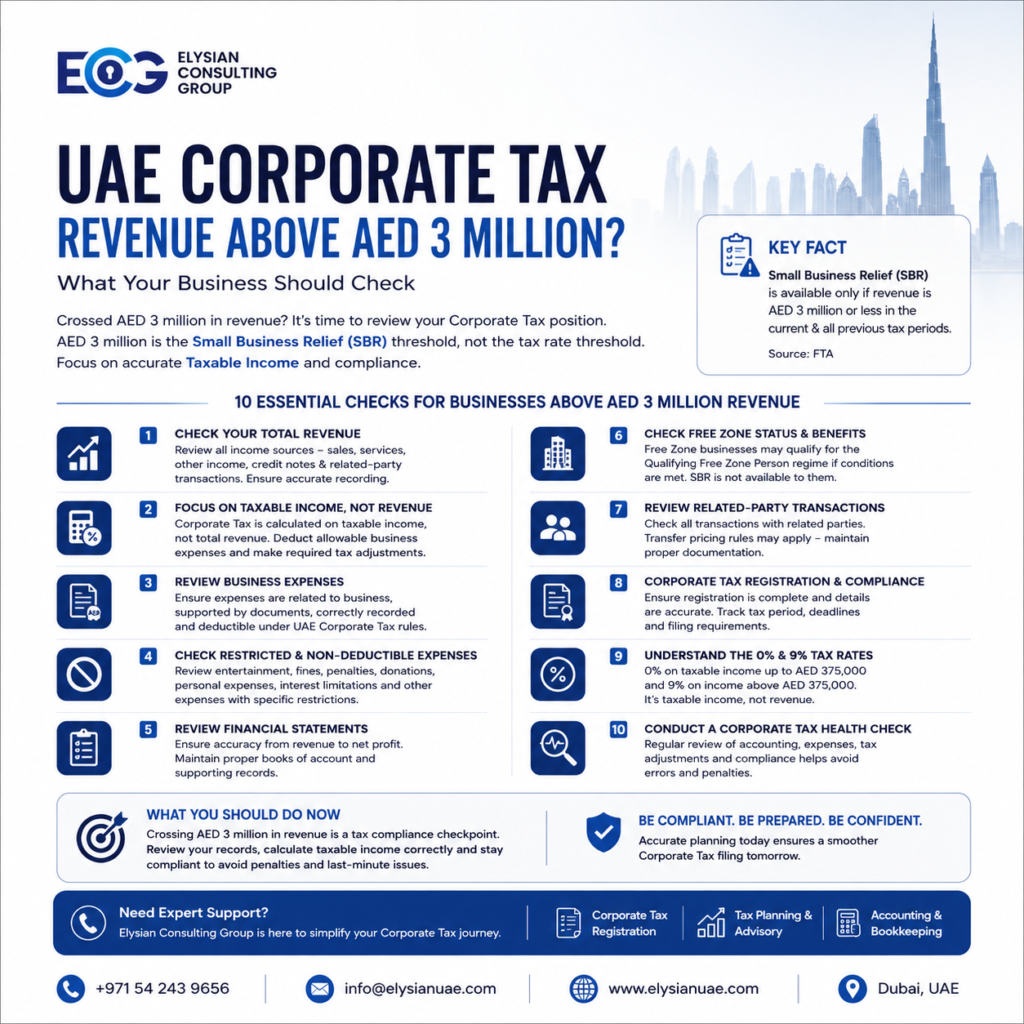
For businesses operating in the UAE, crossing AED 3 million in annual revenue is an important Corporate Tax consideration. The AED 3 million figure is particularly relevant because it is the revenue ceiling for Small Business Relief (SBR), subject to the applicable conditions. The Federal Tax Authority states that eligible resident persons can elect for Small Business Relief where revenue is AED 3 million or less in the current and all previous tax periods.
However, it is important to understand one key point:
AED 3 million is a revenue threshold for Small Business Relief; it is not the UAE Corporate Tax rate threshold.
If your business revenue exceeds AED 3 million, you should review your Corporate Tax position carefully rather than assuming that the entire revenue is taxed at 9%.
This article explains the key areas businesses should check when their revenue exceeds AED 3 million.
1. First, Check Your Total Revenue
The first step is to determine your total revenue for the relevant Corporate Tax period.
Review your:
- Sales invoices
- Service income
- Other operating income
- Credit notes
- Revenue recorded in your accounting system
- Revenue from different branches or business activities
- Related-party transactions, where applicable
Your accounting records should clearly reconcile with your bank transactions, invoices and financial statements.
If your revenue is above AED 3 million, you should assess whether Small Business Relief is available to you. Under the FTA’s published conditions, the relief requires revenue of AED 3 million or less in the current and previous tax periods.
2. Do Not Confuse Revenue With Taxable Income
This is one of the most common Corporate Tax misunderstandings.
For example, suppose a company has:
Revenue: AED 4,000,000
Allowable business expenses: AED 3,300,000
Accounting profit: AED 700,000
Corporate Tax is generally determined based on taxable income, after applying the Corporate Tax rules and relevant adjustments—not simply by applying 9% to AED 4 million of revenue.
The FTA explains that legitimate business expenses incurred to derive taxable income are generally deductible, although specific rules can affect the timing and availability of deductions.
Therefore, businesses exceeding AED 3 million should focus on accurately calculating taxable income.
3. Review Your Business Expenses
A detailed expense review is essential.
Check whether expenses recorded in your accounts are:
- Related to the business
- Properly supported by invoices or other documents
- Recorded in the correct accounting period
- Properly classified
- Deductible under UAE Corporate Tax rules
Common business expenses may include:
- Employee salaries and benefits
- Office rent
- Utilities
- Professional fees
- Business insurance
- Software and subscriptions
- Marketing expenses
- Business travel
- Repairs and maintenance
- Depreciation or amortisation, where applicable
However, not every accounting expense automatically receives the same Corporate Tax treatment.
For example, certain expenses are subject to specific deduction limitations or conditions. Therefore, simply taking accounting profit and applying 9% may not always produce the correct tax calculation.
4. Check Entertainment and Other Restricted Expenses
Businesses should pay particular attention to expenses that have special Corporate Tax treatment.
Entertainment expenditure is an important example. Certain entertainment expenses may only be deductible subject to the applicable limitations.
Other areas that may require review include:
- Fines and penalties
- Donations
- Personal expenses
- Non-business expenses
- Certain interest expenses
- Related-party transactions
- Expenses with specific deduction restrictions
A proper tax adjustment schedule should be prepared before finalising the Corporate Tax return.
5. Review Your Financial Statements
If your revenue has crossed AED 3 million, this is a good time to conduct a detailed review of your accounting records.
Check:
Revenue → Expenses → Gross Profit → Net Profit → Tax Adjustments → Taxable Income
Your financial statements should be supported by appropriate accounting records and documentation.
An accurate bookkeeping system makes Corporate Tax compliance significantly easier because the tax calculation starts with reliable financial information.
Elysian Consulting Group provides accounting, bookkeeping and Corporate Tax compliance support for businesses in the UAE.
6. Check Whether Your Company Is a Free Zone Business
If your business operates from a UAE Free Zone, do not automatically assume that exceeding AED 3 million means the same Corporate Tax treatment applies as it would to every other business.
Free Zone entities have specific Corporate Tax rules and may qualify for the Qualifying Free Zone Person regime if the relevant conditions are satisfied.
At the same time, Small Business Relief is not available to Qualifying Free Zone Persons. The Ministry of Finance has also clarified that Small Business Relief is unavailable to certain other categories, including members of multinational enterprise groups within the specified framework.
Therefore, Free Zone businesses should review their status separately.
7. Review Related-Party Transactions
If your company has transactions with related companies, shareholders, directors or other connected persons, these transactions should be reviewed carefully.
Examples include:
- Management fees
- Intercompany loans
- Shared expenses
- Management salaries
- Related-party purchases and sales
- Service charges
- Transfer of assets
Depending on the circumstances, UAE Corporate Tax transfer pricing rules may apply.
Businesses should maintain proper supporting documentation and ensure that relevant transactions are appropriately reflected in their accounting records and tax calculations.
8. Check Your Corporate Tax Registration and Filing Status
Businesses should confirm that their Corporate Tax registration is complete and that the correct taxable person and tax period are reflected in the FTA records.
Corporate Tax compliance does not end with registration.
Businesses may also need to:
- Maintain accounting and tax records.
- Calculate taxable income.
- Prepare the Corporate Tax return.
- Submit the return within the applicable deadline.
- Pay Corporate Tax within the required timeframe.
- Maintain supporting documentation.
Elysian Consulting Group provides Corporate Tax registration and compliance support to businesses across the UAE.
9. Understand the 0% and 9% Corporate Tax Rates
Another common misunderstanding is that businesses with revenue above AED 3 million automatically pay 9% Corporate Tax on all their revenue.
That is not how the UAE Corporate Tax rate structure works.
The standard structure includes:
- 0% Corporate Tax on taxable income up to AED 375,000
- 9% Corporate Tax on taxable income exceeding AED 375,000
The important word is taxable income, not revenue.
For example, a business could have revenue of AED 5 million but taxable income substantially below AED 5 million after considering allowable expenses and applicable tax adjustments.
10. Prepare a Corporate Tax Health Check
If your revenue has exceeded AED 3 million, conducting a Corporate Tax health check can help identify potential issues before filing.
A practical review should cover:
Accounting Review
- Is bookkeeping up to date?
- Do bank balances reconcile?
- Are receivables and payables accurate?
- Are expenses properly supported?
Revenue Review
- Does revenue reconcile with invoices?
- Are credit notes correctly recorded?
- Are all income sources included?
Expense Review
- Which expenses are deductible?
- Are restricted expenses correctly adjusted?
- Are personal or non-business expenses excluded?
Tax Review
- Is taxable income correctly calculated?
- Has the correct Corporate Tax treatment been applied?
- Are related-party transactions reviewed?
- Are Free Zone rules relevant?
Compliance Review
- Is Corporate Tax registration completed?
- Is the tax period correct?
- Is the filing deadline tracked?
- Are supporting records maintained?
What Should Businesses Do After Crossing AED 3 Million?
Crossing AED 3 million in revenue should be treated as a tax compliance checkpoint, not simply a sales milestone.
Businesses should immediately review:
Revenue → Small Business Relief eligibility → Accounting records → Allowable expenses → Taxable income → Corporate Tax registration → Filing requirements → Supporting documents
Taking action early can help reduce errors and avoid last-minute Corporate Tax filing issues.
Conclusion
If your UAE business has revenue exceeding AED 3 million, do not assume that your Corporate Tax liability is simply 9% of your sales.
Instead, you should review your revenue, accounting records, deductible expenses, taxable income, Free Zone status, related-party transactions and Corporate Tax compliance obligations.
The AED 3 million threshold is especially important when assessing eligibility for Small Business Relief, while the Corporate Tax calculation itself is based on taxable income under the applicable UAE Corporate Tax rules.
A professional Corporate Tax review can help identify potential adjustments and ensure that your financial records are ready for filing.
Need Help With UAE Corporate Tax?
Elysian Consulting Group assists UAE businesses with Corporate Tax registration, tax health checks, accounting and bookkeeping, tax compliance and advisory services.
Visit Elysian Consulting Group to learn more about our UAE tax and accounting services.
Email: info@elysianuae.com
Phone: +971 54 243 9656
Location: Dubai, UAE