Introduction
The United Arab Emirates is moving towards a fully digital invoicing environment with the implementation of the UAE E-Invoicing System. The initiative is designed to improve tax compliance, increase transaction transparency, reduce administrative processes, and enable businesses to exchange invoices digitally through a structured system.
One of the most important steps businesses need to take is the appointment of an Accredited Service Provider (ASP). An ASP will play a central role in enabling businesses to issue, receive, exchange and report electronic invoices in accordance with the UAE’s e-invoicing requirements.
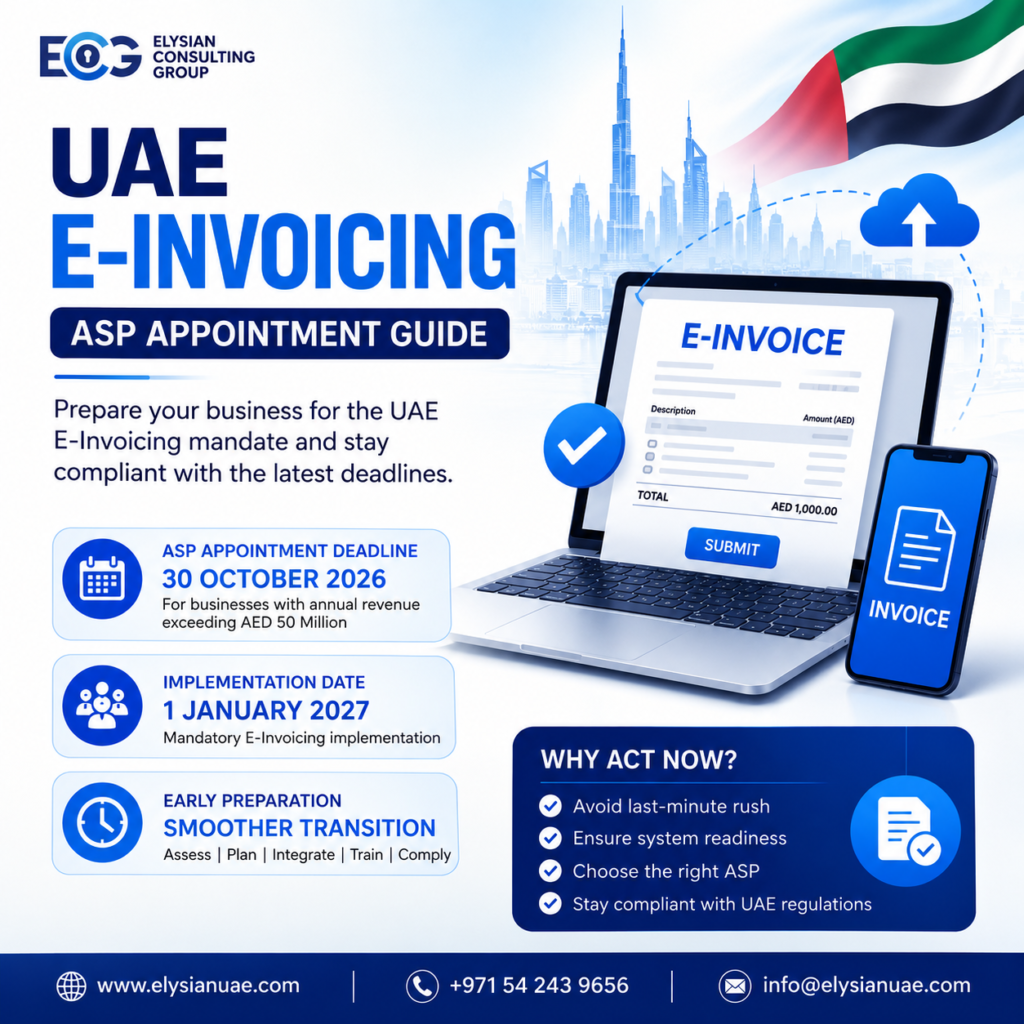
The UAE Ministry of Finance has established a phased implementation timeline. Following a targeted amendment announced in May 2026, businesses with annual revenue exceeding AED 50 million now have until 30 October 2026 to appoint an Accredited Service Provider, while mandatory implementation remains scheduled for 1 January 2027.
For businesses, this means that choosing the right ASP and preparing their accounting systems should not be left until the final deadline.
What Is UAE E-Invoicing?
E-invoicing is the electronic issuance and exchange of invoices between businesses through a structured digital system. It is different from simply creating an invoice in PDF format and sending it by email.
Under the UAE framework, electronic invoices are exchanged through the approved e-invoicing ecosystem, with businesses using an Accredited Service Provider to support the required processes.
The UAE system is based on the Peppol international standard, which is designed to support secure and interoperable electronic document exchange. The Ministry of Finance has stated that the system is intended to improve efficiency, transparency, data integrity and compliance while supporting digital transformation across the UAE.
What Is an Accredited Service Provider (ASP)?
An Accredited Service Provider, commonly referred to as an ASP, is a service provider approved under the UAE e-invoicing framework to provide the technology infrastructure required for electronic invoicing.
The ASP acts as an important connection point between the business and the UAE e-invoicing system.
Businesses will generally rely on their appointed ASP for functions such as:
- Sending electronic invoices
- Receiving electronic invoices
- Exchanging structured invoice data
- Processing electronic credit notes
- Supporting required reporting and transmission processes
- Connecting accounting or ERP systems with the e-invoicing network
- Maintaining the required technical standards
The Ministry of Finance publishes a list of pre-approved e-invoicing service providers, which is updated periodically.
Who Needs to Appoint an ASP?
The UAE e-invoicing framework applies to businesses carrying out in-scope transactions, subject to the applicable exclusions.
The implementation is being introduced in phases.
Businesses with annual revenue exceeding AED 50 million
Businesses with annual revenue exceeding AED 50 million are required to:
Appoint an Accredited Service Provider by 30 October 2026
and
Implement the UAE E-Invoicing System by 1 January 2027.
The ASP appointment deadline was originally 31 July 2026 but was extended to 30 October 2026 by the Ministry of Finance. The mandatory implementation date of 1 January 2027 remains unchanged.
Businesses with annual revenue below AED 50 million
For businesses with annual revenue below AED 50 million, the current implementation timeline provides for:
ASP appointment by 31 March 2027
and
Mandatory implementation from 1 July 2027.
Government entities
In-scope government entities are scheduled to:
Appoint an ASP by 31 March 2027
and
Implement e-invoicing from 1 October 2027.
Businesses should assess their specific circumstances and applicable exclusions rather than relying only on revenue thresholds.
Why Should Businesses Appoint an ASP Early?
Although the deadline for larger businesses has been extended, waiting until October 2026 may create unnecessary implementation pressure.
Selecting an ASP involves more than simply signing a service agreement. Businesses should evaluate how the provider will integrate with their existing accounting, ERP and invoicing systems.
Early preparation allows businesses to:
- Evaluate suitable ASPs
Compare technology, pricing, integration capabilities, support and scalability. - Review existing accounting systems
Determine whether the current ERP or accounting software can support the required e-invoicing process. - Clean and validate master data
Customer, supplier, VAT, product and transaction information should be accurate. - Plan system integration
Businesses may need technical configuration or integration between their accounting software and the ASP. - Test invoice workflows
Testing before mandatory implementation can help identify technical or process-related problems. - Train finance teams
Accounts and finance employees should understand the new invoice workflow and responsibilities. - Reduce last-minute compliance risks
Early implementation gives businesses time to resolve issues before mandatory requirements become applicable.
What Should Businesses Check Before Selecting an ASP?
Choosing an ASP should be treated as an important technology and compliance decision.
Businesses should consider:
1. Accreditation status
Confirm that the provider appears on the Ministry of Finance’s relevant approved or pre-approved service-provider list. The Ministry publishes the list of pre-approved eInvoicing Service Providers and updates it periodically.
2. Accounting software integration
Check whether the ASP can integrate with the company’s existing ERP or accounting software.
3. Peppol compatibility
The UAE e-invoicing framework is based on the OpenPeppol standard, so businesses should understand how the proposed solution supports the required technical architecture.
4. Data security
Invoices contain commercially sensitive information. Businesses should assess the provider’s security, access controls, data protection and system reliability.
5. Scalability
The selected solution should be able to support the company’s future transaction volumes and business expansion.
6. Technical and customer support
Businesses should understand what support is available during implementation and after going live.
7. Total cost
Compare setup fees, integration charges, subscription costs, transaction fees and ongoing support costs before selecting a provider.
E-Invoicing Is More Than a Technology Change
Businesses should not consider e-invoicing simply as an IT project.
It can affect the finance, accounting, tax, procurement, sales and accounts receivable functions of an organisation.
For example, companies should review:
- Customer and supplier master data
- VAT treatment
- Invoice numbering
- Credit note procedures
- Approval workflows
- Accounting software
- ERP integration
- Electronic document exchange
- Internal controls
- Record-keeping procedures
- Finance team responsibilities
A structured implementation plan can help businesses transition with fewer disruptions.
How Elysian Consulting Group Can Help
Elysian Consulting Group helps UAE businesses prepare for tax and financial compliance requirements, including UAE E-Invoicing, VAT compliance, corporate tax, accounting and bookkeeping, and audit and assurance services.
For e-invoicing implementation, businesses can benefit from professional support in areas such as:
- Understanding the UAE e-invoicing requirements
- Assessing business readiness
- Reviewing accounting and ERP systems
- Evaluating ASP options
- Coordinating with technology providers
- Reviewing invoice and tax data
- Supporting implementation planning
- Preparing finance teams for the transition
- Reviewing compliance processes
You can learn more about Elysian Consulting Group and its UAE e-invoicing services through the Elysian Consulting Group website.
UAE E-Invoicing Timeline at a Glance
| Business Category | ASP Appointment Deadline | Implementation Date |
|---|---|---|
| Annual revenue exceeding AED 50 million | 30 October 2026 | 1 January 2027 |
| Annual revenue below AED 50 million | 31 March 2027 | 1 July 2027 |
| In-scope government entities | 31 March 2027 | 1 October 2027 |
The timeline above reflects the Ministry of Finance’s published implementation framework and the May 2026 amendment extending the ASP appointment deadline for businesses exceeding AED 50 million in annual revenue.
Conclusion
UAE e-invoicing represents a major step in the country’s digital transformation and tax compliance framework. For businesses that fall within the first implementation phase, appointing an Accredited Service Provider is an important milestone before the 1 January 2027 mandatory implementation date.
The extension of the ASP appointment deadline to 30 October 2026 gives larger businesses additional time, but companies should use this period to assess their systems, select an appropriate ASP and complete implementation preparations.
Starting early can help businesses avoid rushed system changes, data issues and operational disruption.
If your business is preparing for UAE e-invoicing and you are unsure about your ASP appointment, accounting-system readiness or implementation requirements, professional guidance can help you plan the transition effectively.
Elysian Consulting Group provides practical UAE tax, accounting, audit and e-invoicing support to help businesses prepare for changing compliance requirements.
Author:
Sivaprasad R
Business Development Manager
Elysian Consulting Group
Website: https://elysianuae.com/
Phone: +971 54 243 9656
Email: info@elysianuae.com
Disclaimer: This article is intended for general informational purposes and is based on UAE Ministry of Finance information available as of August 2026. Businesses should review the latest legislation, ministerial decisions and official guidance applicable to their specific circumstances.