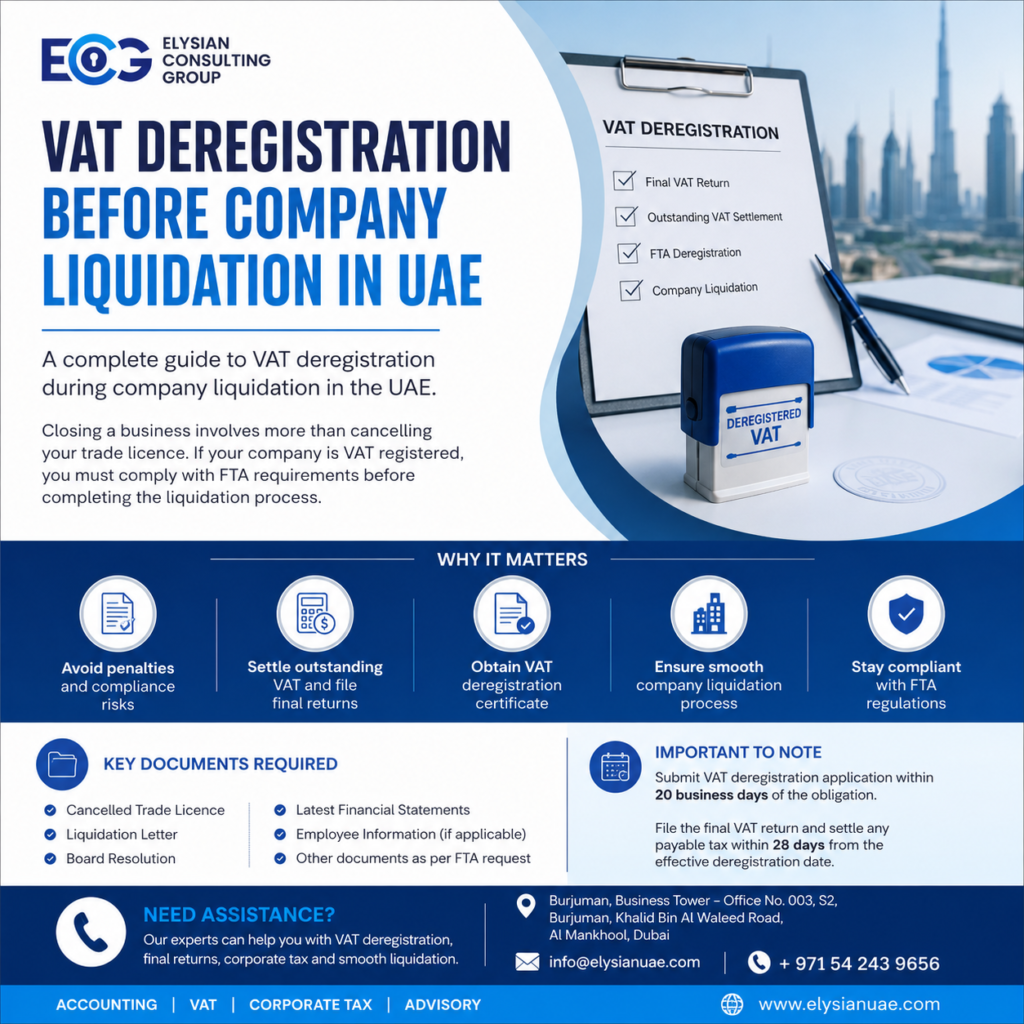
A complete guide to VAT deregistration during company liquidation in the UAE
When a company in the UAE decides to close its operations, company liquidation involves more than cancelling the trade licence. Businesses that are registered for VAT with the Federal Tax Authority (FTA) also need to address their VAT obligations before completing the closure process.
One of the key questions business owners often ask is:
“Do I need to deregister my company from VAT before liquidating the company?”
The short answer is: if the company is registered for VAT and has ceased, or is ceasing, taxable business activities, VAT deregistration is an important part of the closure process. However, VAT deregistration and company liquidation are separate procedures and should be handled correctly.
What Is VAT Deregistration?
VAT deregistration is the process of cancelling a company’s VAT registration with the UAE Federal Tax Authority.
Under UAE VAT legislation, a registered business may be required to apply for VAT deregistration when it ceases making taxable supplies. VAT deregistration may also be relevant where the business no longer meets the applicable registration requirements.
The FTA processes VAT deregistration applications through the EmaraTax platform. Once the application is approved, the business can download its VAT deregistration certificate from its FTA account.
Is VAT Deregistration Required for Company Liquidation?
In many liquidation cases, yes, VAT deregistration should be addressed as part of the company’s tax closure process.
When a company is being liquidated, it generally stops carrying out its business activities and may no longer make taxable supplies. The FTA identifies “business no longer making taxable supplies” as a basis for VAT deregistration and specifically lists documents such as a cancelled trade licence, liquidation letter and board resolution among the supporting documents that may be required.
However, it is important to understand that:
VAT deregistration does not itself liquidate the company.
Company liquidation involves the relevant licensing authority and other closure procedures, while VAT deregistration deals specifically with the company’s tax registration and outstanding VAT obligations.
Both processes therefore need to be coordinated.
Why Is VAT Deregistration Important During Liquidation?
Leaving a company’s VAT registration active after the business has stopped operating can create unnecessary compliance obligations.
A VAT-registered company may still have obligations relating to:
- VAT return filing
- Payment of outstanding VAT
- Final VAT return
- Administrative penalties, where applicable
- Records and supporting documentation
- Tax deregistration
- Clearance of outstanding FTA liabilities
Completing the VAT deregistration process helps ensure that the company’s tax affairs are properly addressed as part of the overall closure process.
What Documents Are Required for VAT Deregistration During Liquidation?
The exact documentation depends on the circumstances of the business and the reason selected for deregistration.
For a company that is no longer making taxable supplies because it is being closed, the FTA currently identifies documents including:
- Cancelled trade licence
- Liquidation letter
- Board resolution
- Latest financial statement, such as a trial balance, profit and loss statement or balance sheet
- Relevant employee information/documentation where required
- Other supporting documents requested by the FTA
The FTA may request additional information if the application is incomplete or further clarification is required.
What Happens to the Final VAT Return?
VAT deregistration does not eliminate the company’s responsibility for its outstanding tax obligations.
According to the FTA, the final VAT return must be submitted and any payable tax settled no later than 28 days from the effective date of deregistration, based on the end of the final tax period.
This makes it important for companies to plan their final VAT filing carefully rather than treating deregistration as simply cancelling the TRN.
The business should review its final transactions, VAT payable, recoverable VAT, assets and other relevant tax positions before submitting the final return.
What About Corporate Tax Deregistration?
Companies closing their operations should also consider their UAE Corporate Tax registration separately from VAT.
The FTA provides a separate Corporate Tax deregistration process for businesses that cease operations. For a cessation of business, the FTA requires documentary evidence proving the cessation of the business.
Therefore, a company undergoing liquidation may need to address:
1. Trade licence cancellation / company liquidation
2. VAT deregistration
3. Final VAT return and settlement of VAT liabilities
4. Corporate Tax deregistration
5. Final Corporate Tax compliance and settlement of applicable liabilities
The exact requirements depend on the company’s legal structure, licensing authority, tax status and circumstances.
VAT Deregistration vs Company Liquidation: What’s the Difference?
It is useful to understand that these are two different processes.
| Company Liquidation | VAT Deregistration |
|---|---|
| Closes the legal/business entity | Cancels the company’s VAT registration |
| Usually handled through the relevant licensing authority | Handled through the FTA/EmaraTax |
| Involves company closure procedures | Involves tax compliance and VAT obligations |
| May require a liquidator depending on the circumstances | Requires the relevant tax deregistration application |
| Deals with the company’s legal/business existence | Deals specifically with VAT registration |
Because the two processes are connected, proper coordination can help prevent delays in closing the company.
What If the Company Has Outstanding VAT?
A company should not assume that liquidation automatically removes its tax liabilities.
The FTA states that tax deregistration does not invalidate the Authority’s right to claim tax due or administrative fines.
Therefore, before closing the company, businesses should review whether there are:
- Outstanding VAT returns
- Unpaid VAT
- Administrative penalties
- Unresolved FTA queries
- Tax adjustments
- Other outstanding tax obligations
Addressing these matters early can make the closure process more efficient.
Can You Obtain an FTA Clearance Certificate?
Businesses may also need evidence that their tax affairs have been addressed.
The FTA provides a Clearance Certificate service through EmaraTax. For business closure cases, the FTA lists financial documentation showing the company’s income from the end of the final VAT period through the date of the clearance application, together with documents proving or supporting the company closure where available.
A clearance certificate can therefore be an important document when completing the company’s overall closure process, depending on the requirements of the relevant authority and the circumstances of the business.
When Should a Company Start VAT Deregistration?
Businesses should not wait until the last stage of liquidation to review their VAT status.
A better approach is to start the tax closure process early and coordinate it with the company liquidation timeline.
The FTA states that where VAT deregistration is mandatory, the application must generally be submitted within 20 business days from the date the deregistration obligation arose.
Early preparation also gives the business time to collect financial statements, liquidation documents, trade licence cancellation documents and other supporting information.
A Practical VAT Deregistration & Liquidation Checklist
Before closing a VAT-registered UAE company, businesses should consider the following:
- Review the company’s VAT registration status
- Confirm the reason for VAT deregistration
- Prepare the required liquidation and company closure documents
- Cancel the relevant trade licence as required
- Review all outstanding VAT returns
- Calculate outstanding VAT liabilities
- Submit the VAT deregistration application through EmaraTax
- Submit the final VAT return after the effective deregistration date, within the applicable deadline
- Settle outstanding VAT and penalties, if any
- Review Corporate Tax deregistration requirements separately
- Apply for an FTA clearance certificate if required
- Maintain appropriate accounting and tax records
Why Professional Assistance Can Help
Company liquidation involves several administrative, financial and tax considerations. When VAT deregistration is handled incorrectly or too late, businesses may face additional compliance issues or delays.
Professional tax and accounting support can help businesses:
- Review their VAT position
- Prepare the necessary financial information
- Identify outstanding VAT obligations
- Coordinate VAT deregistration with the liquidation process
- Prepare and review the final VAT return
- Address FTA queries
- Review Corporate Tax deregistration requirements
- Support the business with tax compliance during closure
At Elysian Consulting Group, we provide accounting, VAT compliance, corporate tax and business advisory services to UAE businesses. Our approach is focused on helping companies manage their tax and compliance requirements with clear and practical guidance.
Final Thoughts
VAT deregistration is an important part of the tax closure process for a VAT-registered company that is being liquidated in the UAE.
However, VAT deregistration and company liquidation are not the same procedure. The company must address its trade licence cancellation, liquidation requirements, VAT deregistration, final VAT return, outstanding tax liabilities and Corporate Tax obligations as applicable.
Getting the sequence right can help reduce compliance risks and make the company’s closure process smoother.
If your UAE company is planning liquidation and you need assistance with VAT deregistration, final VAT return, Corporate Tax compliance or accounting closure, professional guidance can help you complete the process correctly.
Need help with VAT deregistration during company liquidation?
Contact Elysian Consulting Group for professional VAT, accounting, tax and business advisory support in the UAE.
Elysian Consulting Group
Burjuman, Business Tower – Office No. 003, S2, Burjuman, Khalid Bin Al Waleed Road, Al Mankhool, Dubai
Email: info@elysianuae.com
Phone: +971 54 243 9656
Disclaimer: This article is for general information only and does not constitute legal or tax advice. UAE tax and company regulations may change, and the applicable requirements depend on the specific circumstances of each business. Businesses should verify the latest requirements with the Federal Tax Authority and relevant licensing authority or obtain professional advice.