Author: Sivaprasad R – Business Development Manager
Company: Elysian Consulting Group
Website: https://elysianuae.com/
Introduction
The introduction of UAE Corporate Tax has made transfer pricing an important area of tax compliance for businesses operating in the United Arab Emirates.
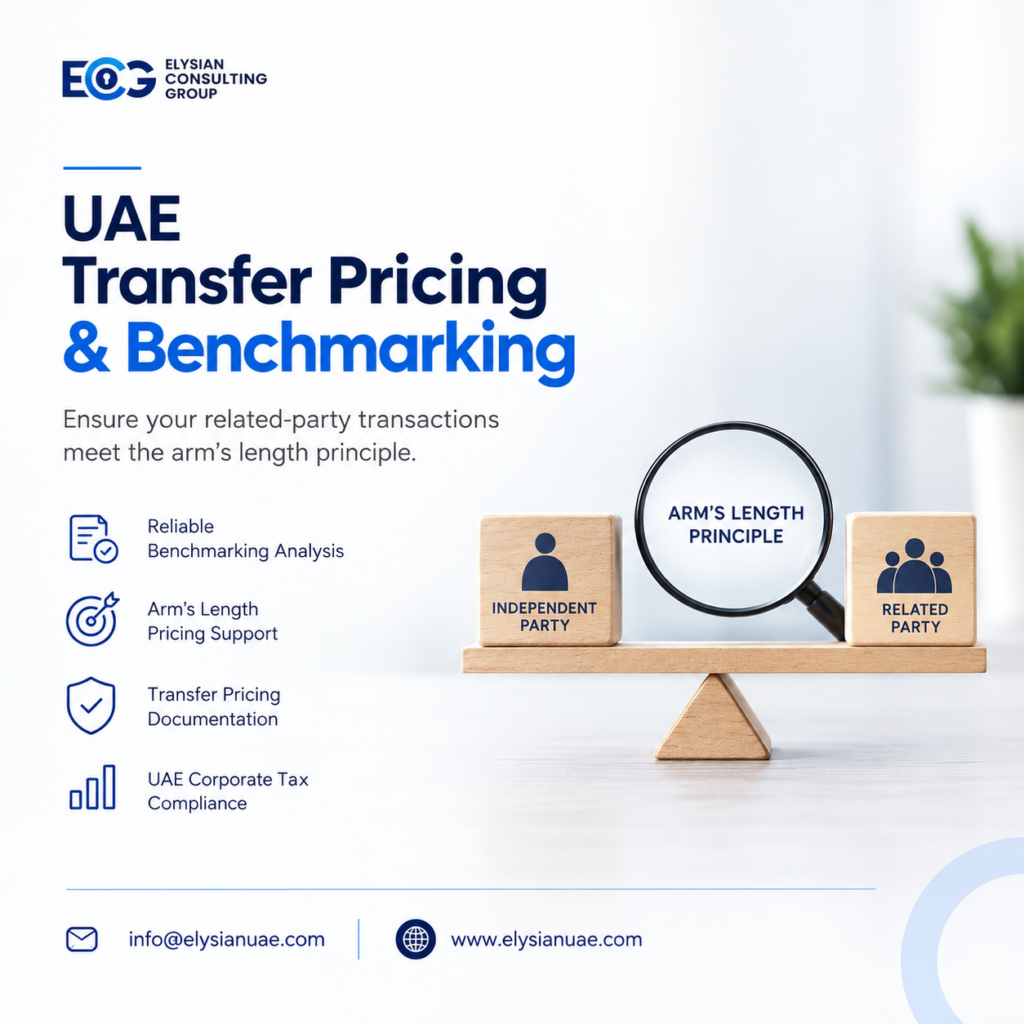
Transfer pricing refers to the pricing of transactions and arrangements between Related Parties and Connected Persons. Under the UAE Corporate Tax regime, these transactions generally need to comply with the Arm’s Length Principle, meaning they should be priced as if the parties were independent of each other.
Importantly, UAE transfer pricing rules can apply to both domestic and cross-border transactions, including transactions involving UAE mainland companies, Free Zone businesses and overseas related entities.
For businesses with related-party transactions, understanding transfer pricing is therefore essential for maintaining proper Corporate Tax compliance.
What Is Transfer Pricing?
Transfer pricing is the process of determining the price or terms for transactions between related businesses or individuals.
Examples include:
- Sale or purchase of goods between related companies
- Management and administrative service fees
- Loans and financing arrangements
- Royalties and licensing fees
- Use of intellectual property
- Shared business expenses
- Intercompany services
- Purchase or sale of assets
- Distribution arrangements
For example, suppose a UAE company purchases goods from a related company located overseas. The price charged for those goods should be consistent with what independent businesses would reasonably agree under comparable circumstances.
The objective is to ensure that the relationship between the parties does not artificially influence the pricing or allocation of taxable profits.
The UAE Federal Tax Authority describes transfer pricing rules as measures intended to ensure that related-party transactions are conducted on arm’s length terms.
What Is the Arm’s Length Principle?
The Arm’s Length Principle is the foundation of UAE transfer pricing rules.
Under this principle, a transaction between Related Parties should produce a result similar to what independent parties would have agreed to under comparable circumstances.
The UAE Corporate Tax Law provides for several recognised transfer pricing methods to determine an arm’s length result.
The principle is important because businesses should not use related-party transactions to artificially shift profits or expenses between entities.
Simple Example
Company A is a UAE company and Company B is its related company in another country.
Company B provides management services to Company A.
If Company B charges AED 500,000 when independent businesses would normally pay only AED 200,000 for comparable services, the transaction may require further transfer pricing analysis.
The company should be able to demonstrate why the price is commercially appropriate and consistent with the arm’s length principle.
Who Is Subject to UAE Transfer Pricing Rules?
UAE transfer pricing rules apply to taxable businesses that enter into transactions or arrangements with Related Parties and Connected Persons.
This can include:
- UAE companies within the same group
- UAE companies and overseas group companies
- Companies controlled by the same owners
- Transactions involving shareholders or other connected persons
- Certain transactions involving directors, officers or related individuals
The FTA confirms that UAE transfer pricing rules apply regardless of whether the Related Party or Connected Person is located in the UAE mainland, a Free Zone or a foreign jurisdiction.
Therefore, businesses should not assume that transfer pricing is relevant only to multinational companies.
Common UAE Transfer Pricing Transactions
Businesses should carefully review transactions involving related entities.
1. Related-Party Sales and Purchases
If companies under common ownership sell goods or services to each other, the pricing should be reviewed to determine whether it reflects market conditions.
2. Intercompany Loans
Loans between related companies are another important area.
Businesses should consider whether the interest rate, repayment terms, security and other conditions are commercially appropriate.
The FTA specifically confirms that transfer pricing rules apply to loans obtained from or granted to Related Parties and Connected Persons.
3. Management Fees
Group companies may charge management, administrative, technical or support fees.
The business should maintain appropriate evidence demonstrating:
- What services were provided
- Who provided the services
- Why the services were required
- How the fee was calculated
- Why the fee is commercially reasonable
4. Royalties and Intellectual Property
Payments relating to trademarks, patents, software, technology or other intellectual property may also require transfer pricing consideration.
5. Shared Expenses
Group companies sometimes share:
- Office expenses
- Staff costs
- IT costs
- Marketing expenses
- Professional fees
- Administrative costs
The allocation methodology should be reasonable and supported by appropriate records.
Transfer Pricing Methods in the UAE
The UAE Corporate Tax Law recognises several methods for determining an arm’s length result.
These include:
Comparable Uncontrolled Price Method
This method compares the price charged in a related-party transaction with the price charged in a comparable transaction between independent parties.
Resale Price Method
This method can be relevant where a business purchases goods from a related party and subsequently resells them to an independent customer.
The resale price is considered and an appropriate gross margin is deducted to determine an arm’s length purchase price.
Cost Plus Method
Under this method, an appropriate mark-up is applied to the relevant costs incurred in providing goods or services.
Transactional Net Margin Method
The TNMM compares the net profit margin earned in a controlled transaction with an appropriate benchmark or comparable independent transaction.
Transactional Profit Split Method
This method may be appropriate where related parties contribute significantly to a transaction and profits need to be allocated between them based on their respective contributions.
The UAE Corporate Tax Law allows these recognised methods to be used individually or in combination, with the most reliable method selected based on the circumstances of the transaction.
UAE Transfer Pricing Documentation
One of the most important aspects of transfer pricing compliance is maintaining appropriate documentation.
Businesses may need to maintain information regarding transactions with Related Parties and Connected Persons, and certain taxpayers may be required to prepare a Master File and Local File.
The UAE’s documentation requirements are set out in Ministerial Decision No. 97 of 2023.
A taxpayer may be required to maintain a Master File and Local File where:
- The taxpayer’s revenue reaches AED 200 million or more in the relevant tax period; or
- The taxpayer is part of a multinational enterprise group with consolidated group revenue of at least AED 3.15 billion in the relevant tax period.
However, the fact that a business does not meet these documentation thresholds does not automatically mean transfer pricing rules do not apply. Transactions with Related Parties and Connected Persons still need to comply with the arm’s length principle where applicable.
What Is a Local File?
A Local File provides detailed information about the UAE taxpayer and its material controlled transactions.
It can include information such as:
- Details of the UAE entity
- Related-party transaction information
- Functional analysis
- Transfer pricing methodology
- Tested party, where applicable
- Financial information
- Supporting analysis
The FTA’s Transfer Pricing Guide explains that the Local File contains detailed information about material categories of controlled transactions and the application of the appropriate transfer pricing method.
What Is a Master File?
A Master File generally provides an overview of the multinational group’s:
- Global business operations
- Organisational structure
- Business activities
- Transfer pricing policies
- Intangible assets
- Financing arrangements
- Financial and tax positions
It provides the wider international context for the UAE entity’s transfer pricing arrangements.
Transfer Pricing Disclosure
Businesses with related-party transactions may also have transfer pricing disclosure obligations.
The UAE Corporate Tax framework allows the FTA to require taxpayers to disclose information about transactions and arrangements with Related Parties and Connected Persons.
The information helps the FTA assess transfer pricing risks and determine whether transactions have been conducted in accordance with the arm’s length principle.
Businesses should therefore maintain accurate records of their related-party transactions throughout the year rather than trying to reconstruct the information only when preparing the Corporate Tax return.
Does Transfer Pricing Apply to UAE Free Zone Companies?
Yes.
A Free Zone company should not assume that transfer pricing rules are irrelevant simply because it operates in a Free Zone.
The UAE transfer pricing framework applies to transactions with Related Parties and Connected Persons, and the treatment of certain transactions can also be relevant when determining whether a Free Zone Person meets the applicable Corporate Tax requirements.
Businesses should therefore review their related-party arrangements as part of their overall Corporate Tax compliance process.
For more information about UAE tax requirements, businesses can also review Elysian’s UAE Corporate Tax Services.
Transfer Pricing and Small Business Relief
Businesses should also consider whether they have elected for Small Business Relief.
The FTA states that businesses claiming Small Business Relief are not required to comply with the transfer pricing documentation rules, although they must still comply with the Arm’s Length Principle.
This distinction is important:
No documentation requirement does not necessarily mean no transfer pricing requirement.
Businesses should assess their specific circumstances before concluding that transfer pricing considerations can be ignored.
How Businesses Can Prepare for UAE Transfer Pricing Compliance
Businesses can take several practical steps to improve their transfer pricing compliance.
Step 1: Identify Related Parties
Prepare a list of companies, shareholders, owners, directors and other persons that may fall within the relevant Related Party or Connected Person definitions.
Step 2: Identify Transactions
Review transactions such as:
- Purchases
- Sales
- Loans
- Management fees
- Service charges
- Royalties
- Expense allocations
- Asset transfers
Step 3: Review Pricing
Determine whether the pricing is commercially reasonable and consistent with the arm’s length principle.
Step 4: Select the Appropriate Method
Consider which transfer pricing method provides the most reliable result based on the nature of the transaction.
Step 5: Maintain Supporting Documents
Keep:
- Agreements
- Invoices
- Payment records
- Calculations
- Benchmarking studies
- Transaction details
- Supporting correspondence
- Financial information
Step 6: Review Before Corporate Tax Filing
Transfer pricing should be considered before finalising the UAE Corporate Tax return so that any required adjustments or disclosures can be identified in advance.
Common Transfer Pricing Mistakes Businesses Should Avoid
Ignoring Domestic Related-Party Transactions
Transfer pricing is not limited to international transactions. UAE domestic related-party transactions can also fall within the rules.
Using Arbitrary Prices
Prices should have a commercial and supportable basis.
Lack of Agreements
Businesses should maintain appropriate agreements for significant intercompany transactions.
Poor Documentation
Even when a Master File or Local File is not mandatory, supporting documentation can be important to demonstrate the arm’s length nature of transactions.
Ignoring Intercompany Loans
Related-party financing should be reviewed carefully, including interest rates and other terms.
Waiting Until Tax Filing
Transfer pricing analysis is better performed throughout the financial year rather than immediately before filing the Corporate Tax return.
Why Transfer Pricing Matters for UAE Businesses
Transfer pricing is more than a tax documentation exercise.
A well-managed transfer pricing framework can help businesses:
- Improve tax compliance
- Strengthen financial controls
- Support related-party transactions
- Reduce tax risks
- Improve corporate governance
- Maintain better documentation
- Prepare for potential FTA enquiries
- Support cross-border business arrangements
For UAE businesses with related-party transactions, having a clear transfer pricing policy can provide greater transparency and consistency.
How Elysian Consulting Group Can Help
At Elysian Consulting Group, we support UAE businesses with Corporate Tax and transfer pricing-related compliance and advisory requirements.
Our approach can help businesses:
- Identify Related Party and Connected Person transactions
- Review transfer pricing arrangements
- Assess arm’s length considerations
- Review intercompany transactions
- Support transfer pricing documentation
- Assist with transfer pricing disclosures
- Identify potential Corporate Tax adjustments
- Strengthen tax compliance processes
You can also explore our Accounting & Bookkeeping Services to maintain accurate financial records that support your tax and transfer pricing compliance.
Conclusion
The UAE Corporate Tax regime has made transfer pricing an important compliance consideration for businesses dealing with Related Parties and Connected Persons.
The Arm’s Length Principle requires relevant transactions to be priced as if they were undertaken between independent parties. Depending on the taxpayer and the nature of its transactions, additional disclosure and documentation requirements may also apply.
Businesses should therefore identify their related-party transactions early, review their pricing, maintain appropriate supporting documentation and consider transfer pricing requirements when preparing their UAE Corporate Tax returns.
If your UAE business has related-party transactions and you are unsure whether transfer pricing requirements apply, obtaining professional advice can help you understand your obligations and reduce potential compliance risks.
Need Help With UAE Transfer Pricing?
Elysian Consulting Group provides tax, accounting and advisory services to businesses across the UAE.
Website: www.elysianuae.com
Email: info@elysianuae.com
Phone: +971 54 243 9656
Author: Sivaprasad R
Business Development Manager
Elysian Consulting Group